
Achieving the "New Ostrich Industry" Production Standards
The Correct Path to "The New Ostrich Industry"
By Fiona Benson, Blue Mountain International
& Daryl Holle, Blue Mountain Feeds, Inc.
The Influence of Nutrition:
The influence of Nutrition is an essential factor if the production targets of the New Ostrich Industry are to be achieved and over time improved upon.
Farmers will have to decide on what basis they will be selecting birds. First it is important to recognise that there must be a feeding program in place that enables the effects of the poor nutritional programs bred out and the inherited traits of the birds to be achieved.
It should go without saying that every egg needs to be recorded by Breeder and provided a unique number and every bird on the farm requires identification from the moment of hatch. Extensive records must be kept and include:
| In The Breeders: | |
| Egg Production Fertility Hatchability Infection |
| In the Progeny: | ||
| Any Defects Feed Conversion Weight Gains Meat Yields/Conformation |
||
| Muscle Size % Primary to Secondary Muscles |
||
| Skin Quality | ||
| Skin Size Quill Cover Quill Pattern Quill Size Hair Follicles & Pinholes |
The first few years of the selection program will need to be harsh. We have visited farms where the records clearly show little or no production from many of the breeder birds. The reason these birds have not been culled is as a result of the very high price that the producers have often paid. With the industry in its infancy for the most part so long as a bird was 2m tall and had feathers they have been changing hands for large sums of money, and therefore producers have been loathe to cull these birds in the hope that they will one day become productive.
| Year 1 | Introduce Professional Levels of Nutrition. Introduce Intensive Levels of Feed and Farm Management. Introduce Extensive Record Keeping. |
| End of Year 1 | Utilise Records to Cull Breeder Stock. Introduce Fresh Genetic Breeder Stock. |
| End of Year 2 | Utilise Records to Cull Breeder Stock. Introduce Fresh Genetic Breeder Stock. |
| Year 3 & 4 | Continue same policy. Utilise Records. Group Offspring on Genetic Performance. |
| Year 5 | Continue above policy. Commence Challenge Feeding Program. |
| End of Year 5 | Continue above policy. Breeding Flock will begin to achieve close to New Ostrich Industry Targets. |
| End of Year 8 | Offspring should far surpass current targets. |
| Year 10 | Extremely Cost Effective Meat Production with HIGH PROFIT POTENTIAL |
There have been many extremely poor nutritional programs practiced on farms…most through ignorance of the long-term damage that this can cause. However, it must be remembered this leaves a legacy that in many cases is irreversible. For example insufficient levels of Vitamin E and/or Vitamin B1 for an extended period of time can lead to permanent sterility. There is clear evidence in recent years of birds reproductive organs reducing in size and late developing as a result of the poor levels of nutrition that have become the norm on many farms. In reverse…those farms that have introduced high standards of nutrition have seen a steady improvement in the production performance of their birds.
To aid producers and purchasers of breeder birds to understand the influence of nutritional history on the production potential of the bird, we have introduced a "Nutritional Classification" system to enable us to classify the nutritional viability of a farmers birds. You can review this system by clicking on the following link:
In the early years of a genetic improvement program it will be important to remember the nutritional influence as this can mask the high performing inherited genetic characteristics of the birds. The best genetic birds will always be the first to ‘crash’ when they are not nutritionally supported to match their potential levels of production. These types of birds are the first to become nutrient deficient in their efforts to support their inherited production potential.
I have heard farmer’s being told that given the cost of feed is the major input it is important to make sure their rations are ‘cheap’ when measured by cost per tonne. We would suggest rather it is important to make sure your rations are ‘cost effective’. These birds have tremendous production potential…but to achieve this production the rations must be designed to support these high levels of production. No genetic improvement program can be carried out without this in place first or incorrect decisions will be made.
Selection Criteria:
With good records in place it is possible to identify the good performing birds. It is also necessary to understand the genetic influence on muscle development and feed conversion. Production abilities in quantity of eggs laid are an important criteria,
but so is confirmation. Temperament of the male is also most important and has a significant influence on the production potential of the hens.
There are no clear guidelines as yet on how to judge a good bird. To produce quality meat birds clearly a good frame is essential on which to build muscle. Blue Mountain has established what we consider to be the key measurement points. The measurements for this hen can be used as benchmark standards.
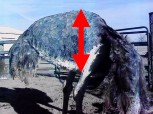
Figure 1 - Body Depth
A quality bird should have good depth. Measure from the top most part of back to the bottom of her fat pan area---just behind the legs. The measurements on this hen: 27 inches (68.7cm).
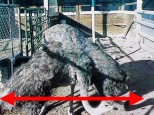
Figure 2 - Wing Span
The wingspan of this hen, when fluttering is between 7-8 feet (2.1-2.4m). Exact measurement of wingspan is not possible to achieve accurately.
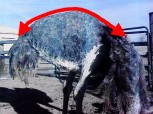
Figure 3 - Body Length
Measure from the base of the neck to the very base of the tail. This hen measures 45 inches (1.14m) from the very base of neck to the very base of her tail. Measure from where the neck goes into the back and exactly where the tail begins to rise from the back.
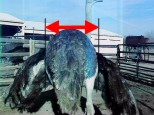
Figure 4 - Body Width
Take an imaginary line from outside the drum muscles and measure straight across the back. The measurement on this hen is 26 inches (66.04cm).
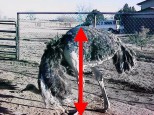
Figure 5 - Height
Height measurements need to be read with care…there are many tall birds with poor frames. The height must be accompanied with good depth, width and length of frame. This hen measures 59 inches (1.5m) from the ground to the highest point on her back.
Height will also be influenced by breed…whether a Red, Blue or Black. It must be remembered that a bird that is not nutritionally supported to achieve correct growth from Day 1 will suffer stunted growth and underdevelopment of the true inherited genetic traits. There are some genetics that do not have the inherited ability to become good meat birds...so it is important to recognise that these genetics can only be identified when on a nutritional program that enables their full genetic potential to be realised.
It is important to remember also that the condition of the bird will have an influence on the measurements. The hen in these pictures is in perfect condition at the start of her breeder season. She is well muscled with excellent feather growth. She is 3 years of age and produced in excess of 80 eggs in her first season as a two year old. She laid her first egg of the 2001 season on 2nd of February, a couple of weeks after the photographs were taken. There was a severe snow storm during that period. She is a Class 3 bird on the above Nutritional Classification system.
There is much work to be done on genetic development of the specie and that work needs to start now. The New Ostrich Industry Production Targets that we have set are very achievable with a dedicated 5year program. With a further 5 year development program combined with Feeding Programs designed to Challenge the genetic potential within the birds, we will see these Production Targets well exceeded.
We predict the conversion figures as laid out in the current Targets being halved when following a strict genetic selection program combined with the correct nutritional and nutritional classification program. This makes the economics of raising Ostrich extremely attractive.
The End
Last modified on Friday, June 07, 2002