BLUE MOUNTAIN OSTRICH LEATHER GRADING SYSTEM©
July 25, 2001
Version 4.0
PURPOSE:
This unique Ostrich Leather grading system accomodates a wider variety of hide qualites including flawless and nearly flawless hides. This system is base on experience from processing Blue Mountain Ostrich and will be frequently updated as new information is compiled.
AIM:
Our aim is to provide a widely accepted means by which the quality of Ostrich leather can be assessed and thus to form a basis for pricing.
BASIS FOR THE GRADING SYSTEM:
The grading system is based on identifying visible defects, both natural (such as a healed wound scar), and man made (such as a hole caused by a knife during the flaying process). The grade of the skin will depend on the number, size and distribution of the defects on the skin.
DEFINITIONS:
1. A defect is - a hole, a tear, a scratch, a loose scab, a healed wound or extensive bacterial damage.
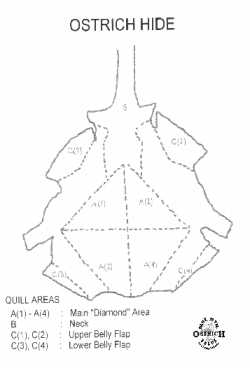
2. The Diamond is the main diamond shaped quill area in the middle of the skin.
3. The four quarters of the Diamond are defined by dividing lines as follows:
The dividing lines divide the Diamond area into four quarters. The vertical line is from the base of the neck to the bottom of the Diamond. The horizontal line crosses the Diamond at it's widest point.
THE GRADES:
Hides can be classified into 6 different grades:
| GRADES |
| Super Premium |
| Premium |
| Grade #1 |
| Grade #2 |
| Grade #3 |
| Grade #4 |
GRADE DEFINITIONS:
SUPER PREMIUM
Virtually a flawless hide--No visible defect to all four quarters or surrounding hide.
PREMIUM
No visible defect to all four quarters. The area outside the crown may have a few less visible defects.
GRADE #1
Three quarters of the Diamond must be free from defects. One quarter may have a defect(s) not larger than 25mm by 25mm (approximately 1 inch square). The area outside the crown may have a few visible defects.
GRADE #2
Two quarters of the crown must be free of defects. Two quarters may have a defect(s) not larger than 25mm by 25mm (approximately 1 inch square). There may be defects on the area outside the crown.
GRADE #3
One quarter of the Diamond must be free of defects. Three quarters may have a defect(s) not larger than 25mm by 25mm (approximately 1 inch square). There may be defects on the area outside the Diamond. Shall have a minimum area size of one A4 size panel that is free of defects.
GRADE #4
All four quarters may have a defect(s) not larger than 25mm by 25mm (approximately 1 inch square). There may be defects on the area outside the crown.
| GRADE | Defect 4 Qtrs. | Defect 3 Qtrs. | Defect 2 Qtrs. | Defect 1 Qtr. | Defects Outside Crown |
| Super Premium | NONE | NONE | NONE | NONE | NONE |
| Premium | NONE | NONE | NONE | NONE | MINOR |
| Grade #1 | NONE | NONE | NONE | YES | MINOR |
| Grade #2 | NONE | NONE | YES | YES | YES |
| Grade #3 | NONE | YES | YES | YES | YES |
| Grade #4 | YES | YES | YES | YES | YES |
FACTORS WHICH MAY AFFECT PRICES
The following factors may affect the value of Ostrich leather to particular clients. Accordingly, it is wise to discuss the clients requirements and take specific requests (for example that tick bite scars are not to be considered a defect) into account when selecting hides for the client, and when agreeing prices. Where appropriate, the specific requirements of the client can be agreed by way of samples.
CLIENT GRADING REQUIREMENTS
We recognise that Ostrich leather is a natural product with a range of defects and appearance. It is possible that certain defects are of no consequence to some clients, while they might be very important to others.
COLOR VARIATIONS
By the nature of the product and the dying process, it is inevitable that differences in color will appear, both between orders and within a particular order. Where this is important to the client, it is good practice to provide ‘top' and ‘bottom' samples to specify the acceptable range. Single samples supplied for indicating color and color swatches and shade cards are only to be regarded as indicative of the color of leather subsequently supplied.
TANNING
It is a good practice to discuss the specific requirements of the client regarding tanning. Appropriate samples can be prepared and used in selecting the particular hides desired by the client.
QUILL PATTERNS, QUILL SIZE & QUILL FINISH
The quill pattern and size will depend on factors such as the age and genetics of the particular animal. These factors and the finish to the quills can be discussed with the client, and where appropriate, acceptable samples can be prepared and used in selecting hides desired by the client.
HAIR FOLLICLES (FILOPLUMES)
Hair follicles (Filoplumes) are thought to be genetic, and we do not consider them to be defects. Where the client considers them to be undesirable, this should be established prior to order.
SIZE
The majority of Ostrich hides are larger than 12 square feet, with the average being between 14 and 15 square feet. Unless the client specifically specifies something different, selection should be on this basis.
THICKNESS
Thickness will vary in any batch of hides. Where the client has specific requirements, this should be established prior to order and incorporated into the order.
Developed by:
Fiona Benson
Daryl Holle
Blue Mountain Ostrich Leather
Last modified on Friday, June 07, 2002